.jpg)
An African Moses In America - Moses Dangba

After this, I looked, and behold, a great multitude that no one could number, from every nation, from all tribes and peoples and languages, standing before the throne and before the Lamb, clothed in white robes, with palm branches in their hands. - Revelation 7:9
A Beautiful Place
Moses Danga remembers a beautiful place in his native South Sudan. This "place" appeared regularly even during civil unrest, famine, and war -- things Moses experienced as a child in his small town of Maridi, near the border with Zaire. This "place" appeared when the Christians in his town came to worship. People from different ethnic groups singing the same hymn in different languages brought a transcendent joy, even a reminder to him of a worship St. John described in Revelation 7:9. "I looked and saw a multitude too large to count, from every nation and tribe and people and tongue, standing before the throne and before the Lamb."
"This Moses Will Bring His People to a Different Life"
Moses was one of eleven children. Certainly a challenge to provide for in war-torn South Sudan. It is not unusual for a relative to offer to take and raise a child, lessening the burden. When he was nine years old, his pastor grandfather took the boy under his wing and changed his African name to "Moses," because, he said, "This Moses will bring his people to a different life." This began the boy’s preparation to become a missionary.
"I was following him around, learning from him." He was taught Bible stories and hymns. As he grew, he not only went on pastoral calls with his Pastor grandfather but was supervised to pray in public, to teach, and to preach. As a teenager, his grandfather sent Moses to Khartoum, North Sudan, to a preparatory boarding school. Only when he graduated from this school would he be allowed to go to college.
No Bibles, No Teachers
When he arrived in Khartoum, the police in what was then the Northern part of a united Sudan confiscated his Bible. "I never thought they would take my Bible. We needed the Bible for school. When we entered the school, each of us had to choose to study Islam or Christianity. While there were books and teachers for the classes in Islam, there were no Bibles or teachers for us. So, I left the fifteen Christians who chose not to study Islam. With no Bibles, we taught ourselves, training with regular remembrance. We sang the hymns we learned as children. We had to hide during school because our Christian classes were held in the afternoon and at night. But with God's help every one of us passed the exam for Christians."
Education and Calling
His grandfather's preparation had been a blessing. Then the stakes increased. Having graduated from the boarding school, he was qualified to fulfill his grandfather's dream -- he could attend college, earn a degree, and a better life for the family he had left behind. But now the rule had changed. Civil war had broken out. First, he and the others would have to agree to join the army of North Sudan to fight the Christians of South Sudan. Some agreed to join; Moses and several others refused, and were detained by the police. There was a good chance they would be shot.
Ministry in Prison
Moses continued to lead the prisoners, as it turned out, to Egypt. He led preaching and teaching the Bible in prison. The hymns and prayers of the former boarding school students were a witness to those around them. By God's grace, their jail door was opened - Then, in 1998, a door opened – to Lebanon. In Lebanon for two years he found work, attended a Christian college, and married a wonderful young woman he had met in Khartoum. In 2000, America's door opened and welcomed the refugees. They found a new home in Lansing, Michigan.
A Missionary to His Own People
Rev. David Theile, a Lutheran pastor in East Lansing had an opportunity which was turning into a frustration. Young men from Sudan, some of the “lost boys,” had found refuge near his church. They had escaped the murderous civil war in South Sudan to come to a new country that cared for them. Christ Lutheran welcomed the young men, many of whom did not speak English. Pr. Theile needed someone who knew their language and culture, someone from South Sudan who could lead them to Jesus. That is when he met a Christian evangelist from South Sudan, Moses Dangba.
Moses became the church’s missionary to lead African immigrants from several countries to Jesus. When the Africans worship together, each using their own language to sing praises to God, it is something beautiful. Moses’ grandfather’s prophecy was realized.
Missionary to America
Martin Luther in “Admonition to Prayer,”( Luther’s Works, V. 43, p.239) has something to say to Moses’ grandfather, and to you and me.
“I strongly urge that children be taught the Catechism. Should they be taken captive in an invasion, they will at least take something of the Christian faith with them. Who knows what God might be able to accomplish through them?”
Check out Moses' full story below!
More Stories Like This One
At Mission Nation Publishing, we inspire and equip churches to reach new ethnic groups in America with the gospel of Jesus. One of the ways that we do this is by publishing the stories of immigrants. If Alex's story inspired you, I would encourage you to check out our book collection and find more stories that show God's unfailing love through His people.
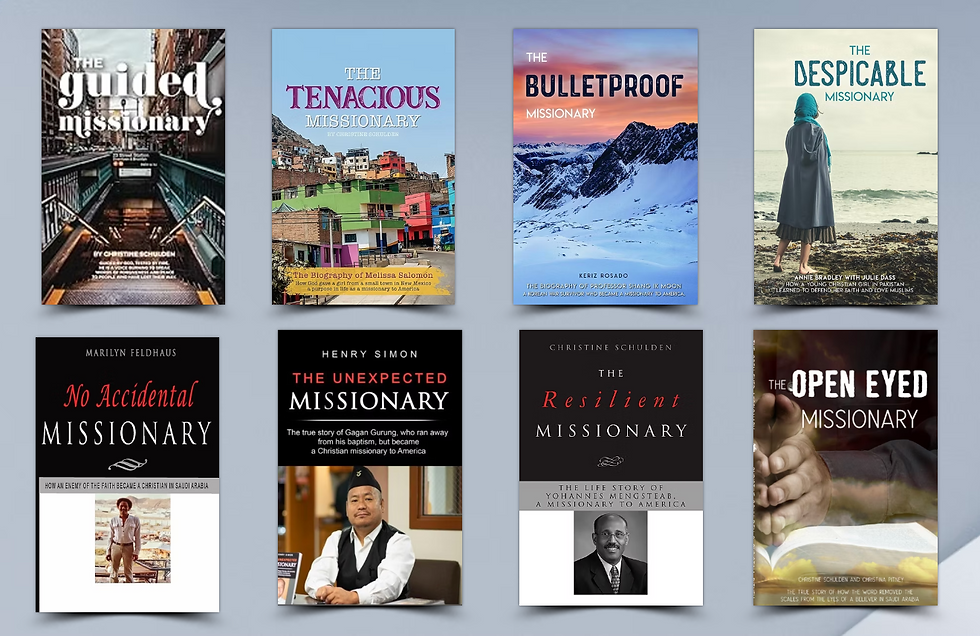
I want to invite YOU to check out our books, where you can learn more about what it means to engage with your community and better serve those around you. Click HERE to see our books. Specifically, I want to point you to Together in Mission. This resource is designed both
for congregations preparing to step into cross-cultural ministry and for those already engaged in it. It serves as an introduction to the vision of Revelation 7:9 and the work we carry out at Mission Nation, helping you move forward grounded in the Word and equipped for the work ahead.

Rev. Dr. Bob Scudieri
Founder of Mission Nation Publishing
Mission Nation Publishing is dedicated to inspiring and equipping churches across America to effectively engage with and minister to new ethnic groups by amplifying the powerful stories of immigrant missionaries and fostering diversity within Christian communities.
Thank you for journeying with me through this exploration of ministry tools. May your efforts bear fruit and your community flourish.


Comments